
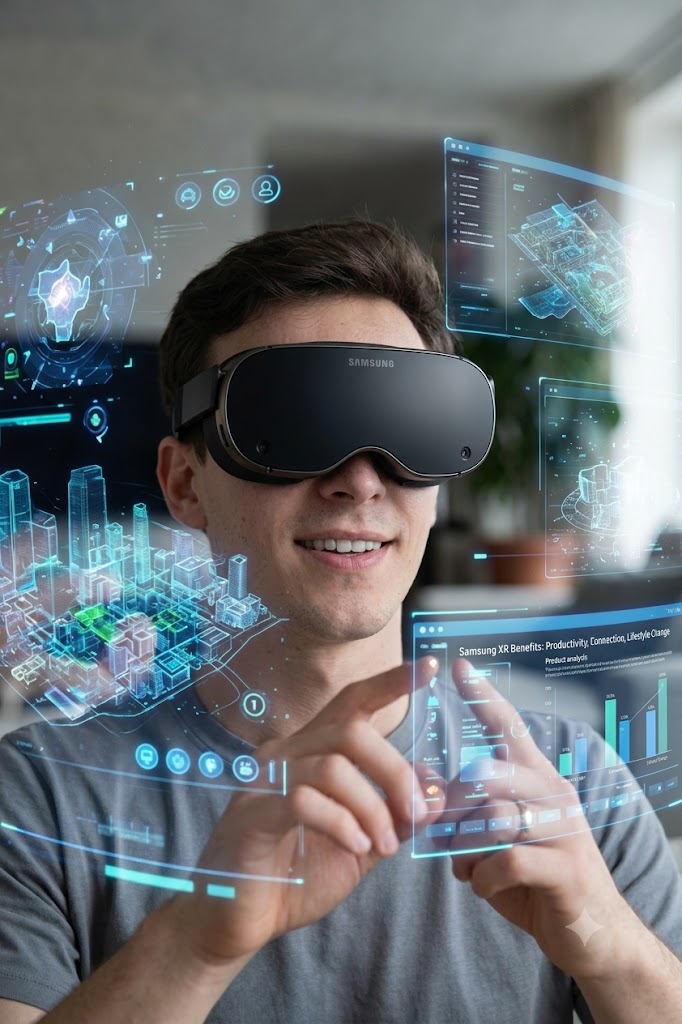
The race for leadership in spatial computing has gained a revolutionary chapter with the official launch of Samsung's new XR glasses. Developed in a strategic partnership with Google and Qualcomm, the device is not limited to being just another technological accessory, but rather a promise of an era transition: moving away from two-dimensional smartphone screens toward a three-dimensional interaction integrated into our surroundings. By uniting Augmented Reality (AR) and Virtual Reality (VR) under the concept of Extended Reality (XR), the South Korean giant delivers a product that redefines the boundaries between the physical and digital environments.
To understand the impact of this innovation, it is essential to highlight how the device transforms human routine and productivity. Unlike older virtual reality concepts that completely isolated the user, the new XR glasses utilize ultra-high-definition cameras and advanced sensors to map the environment in real time. This allows work windows, complex graphics, internet browsers, and entertainment content to float in your living room or office in an ultra-realistic way. The precision of eye and gesture tracking eliminates the need for physical controllers, making the interface as intuitive as looking and pinching your fingers in the air.
The practical benefits for humanity extend across multiple sectors, starting with the professional and educational environments. Engineers, designers, and doctors now have the ability to project and manipulate full-scale holographic models, accelerating diagnoses, simulated surgeries, and the development of complex products. In education, knowledge absorption reaches unprecedented levels by allowing students to explore historical events, distant ecosystems, or molecular structures in an immersive and interactive way. Geographical distance ceases to be a barrier, transforming business meetings and classrooms into highly realistic virtual gathering spaces.
Beyond productivity, the true life-changing aspect brought by this technology lies in how we consume entertainment and connect with other people. Watching a movie or attending a sporting event through Samsung's XR glasses offers a genuine sense of physical presence, featuring adjustable virtual screens that surpass the dimensions of any conventional movie theater. The ecosystem integration with the Android platform adapted for XR ensures an exponentially growing library of applications, allowing artificial intelligence to guide the user through daily tasks, display floating directions on the streets, or perform simultaneous translations directly within their field of vision.
Faced with such an advancement, the question remains: is it worth buying Samsung's new XR glasses right now? If your goal is to place yourself at the forefront of technology, optimize digital workflows, and experience the beginning of the replacement of traditional computers, the answer is a resounding yes. Although the initial investment reflects the pioneering spirit and cutting-edge engineering contained within the device, the benefits in innovation, efficiency, and the profound transformation of the human experience justify the device as the most important milestone in consumer technology of this decade. The future is no longer something we look at through a screen; it is the space where we choose to live.
Leave a Reply