
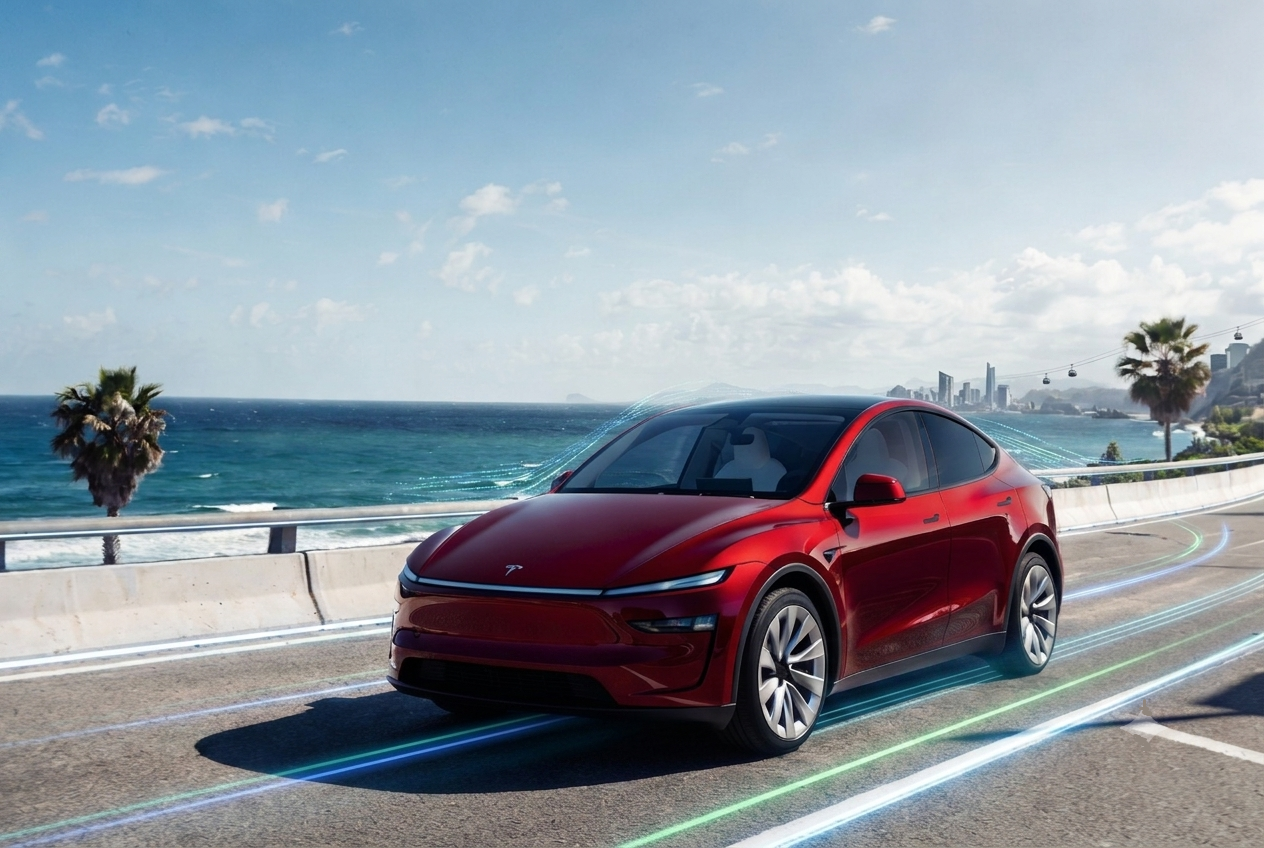
The roar of internal combustion engines, which echoed as the ultimate symbol of industrial progress over the last century, is being silenced by an almost imperceptible yet infinitely more powerful hum. The global automotive industry is undergoing its greatest transformation since Henry Ford rolled out the first assembly line. This is not merely a change of fuel, but a complete redefinition of what an automobile represents. At the center of this historic turning point, Tesla has evolved from an audacious startup into the compass pointing toward where humanity is heading.
Looking ahead at the next 10 to 20 years means understanding that the electric vehicle (EV) is no longer a promise for tomorrow; it is the foundation of the connected and sustainable society we are building today.
The Tesla Effect and the Global Automakers' Race
To say that Tesla revolutionized the market is no understatement. Under the leadership of Elon Musk, the company proved to the world that electric vehicles could be fast, desirable, technological, and, above all, highly profitable. Models like the Model 3 and the Model Y have transformed the automobile into a "computer on wheels," capable of updating its features overnight through software updates.
This resounding success has forced traditional automotive giants to accelerate their own survival timelines. Today, legacy brands such as BYD, Volkswagen, BMW, General Motors, and Hyundai are investing hundreds of billions of dollars to electrify entire fleets. Competition has shifted from who builds the best piston engine to who delivers the best battery efficiency and the smartest software ecosystem.
The Climate Commitment: Global Agreements and the End of Pollution
The transition to electric mobility is the primary tool for nations to meet the strict emission caps stipulated in the Paris Agreement. ,Governments worldwide have realized that the transportation sector is one of the biggest culprits behind global warming. In response, an unprecedented wave of legislation has emerged: the European Union and several US states, such as California, have already set clear mandates to ban the sale of new internal combustion engine cars by 2035.
The environmental impact of this shift over the next two decades will be monumental. The massive replacement of fossil fuels with electricity—especially as global energy grids migrate toward clean sources like solar and wind—will result in a drastic reduction of carbon dioxide (CO2) and particulate matter in major metropolises. Shrinking this dependence on oil means not only slowing down climate change but also saving millions of lives cut short annually due to respiratory illnesses aggravated by urban pollution.
Outlook 2036-2046: The Reality in the US, the World, and Brazil
The pace of this revolution, however, outlines distinct scenarios depending on the region of the planet:
- In the United States and Europe: Ultra-fast charging infrastructure (led by Tesla’s Superchargers network) is already a mature reality. Within the next 10 years, the cost of purchasing an EV will be lower than that of a conventional car, making electrification the default choice for virtually 100% of new vehicle buyers.
- On the Global Stage: China leads in production volume and adoption, exporting affordable EVs to all continents and mass-deploying the technology at record speeds.
- The Reality in Brazil: The Brazilian market possesses a unique and fascinating dynamic. Being a country of continental dimensions that relies heavily on road transport, the challenge of highway charging infrastructure still delays mass adoption compared to the US. However, Brazil holds a major trump card with ethanol and renewable biofuelswhich is driving a powerful hybrid transition. Over the next 15 to 20 years, 100% electric cars will dominate corporate fleets, ride-hailing services, and the urban centers of major Brazilian capitals, while the countryside will see a strong consolidation of hybrid engines.
The Big Question: Will Cars Become Autonomous in Brazil Too?
Electrification is only the first half of the revolution; the second half goes by the name of autonomous drivingSystems like Full Self-Driving (FSD) from Tesla aim to completely eliminate the need for a human driver, promising to reduce accidents by more than 90%. But will this technology work outside the highly signaled environment of the United States?
In the US, the transition to Robotaxis (100% autonomous cars without drivers) is expected to consolidate within the next decade, drastically changing the concept of car ownership—many people will simply stop buying vehicles and instead subscribe to autonomous transportation services.
And what about Brazil? The challenge here is considerably greater, but the answer is yes, we will have autonomous carsalbeit at a different pace. The artificial intelligence of autonomous vehicles relies on high-precision maps, perfectly painted lanes, flawless signage, and, above all, predictable traffic behavior. Due to chronic inconsistencies in Brazilian road infrastructure and the chaotic traffic of its metropolises, full autonomy (where the driver can sleep in the backseat) will arrive first in a controlled manner: on top-tier toll highways, express bus lanes, and high-income master-planned neighborhoods. Brazil will demand a much more refined level of cultural adaptation and terrain reading from Tesla’s lines of code and other automakers, but the safety and economic efficiency of this technology will make its long-term implementation inevitable.
Conclusion: The Space Where the Future Happens
The electric and autonomous mobility revolution is not just about changing the engine under the hood; it is about reclaiming the quality of the air we breathe, giving billions of hours lost in traffic jams back to human well-being, and designing quieter, smarter cities.
Companies like Tesla have paved the way, but the final destination belongs to all of us. Twenty years from now, looking at an exhaust pipe emitting smoke will seem as archaic as looking at a typewriter. The future is accelerating toward us, and it is electric.
Leave a Reply